
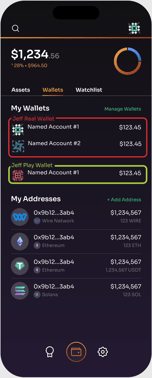
Wallet
A wallet is created from a recovery phrase and serves as the foundation for managing your digital assets.
Think of it like your online banking profile. It can contain one or more accounts, all protected by the same recovery phrase.
- Your recovery phrase is the backup key to your wallet.
- All accounts within the wallet are controlled by that recovery phrase.
Account
A account is an individual account within your wallet.
Think of it like a checking account or savings account inside your online banking profile.
Every account has its own balances and can hold assets across multiple supported blockchain networks.
You can create multiple accounts to organize your assets however you'd like.
Examples include:
- Personal
- Long-Term Holdings
- Trading
- Family
Address
An address is a unique public identifier used to receive assets. Think of it like an account number.
When someone sends you cryptocurrency, they send it to one of your wallet addresses.
Each account contains addresses for supported blockchain networks.
Because addresses are public, it's safe to share them when receiving funds. Never share your recovery phrase or private keys.
How It All Fits Together Creating a Wallet
When you create a new wallet in WireUp:
- A recovery phrase is generated.
- Your wallet is created.
- Your first account is automatically created.
- Addresses for supported blockchain networks become available.
Accounts Inside Your Wallet
Every wallet starts with one account. You can create additional accounts at any time to better organize your assets.
Each account can:
- Hold assets across supported blockchains.
- Be renamed for easier organization.
- Have its own transaction history.
- Contain addresses for supported blockchain networks.
Importing an Existing Wallet
You can import an existing wallet from WireUp or another compatible self-custody wallet using its recovery phrase.
When imported:
- The recovery phrase creates a wallet inside WireUp.
- Associated accounts become available.
- Supported addresses and assets are restored.
If you import multiple recovery phrases, you can switch between wallets and choose which wallet new accounts belong to.
Example
Think of it like this:
- Recovery Phrase → The master backup for your wallet.
- Wallet → Your online banking profile.
- Account → A checking or savings account inside that profile.
- Address → The account number someone uses to send you money.
Each piece works together to help you securely organize and manage your digital assets.